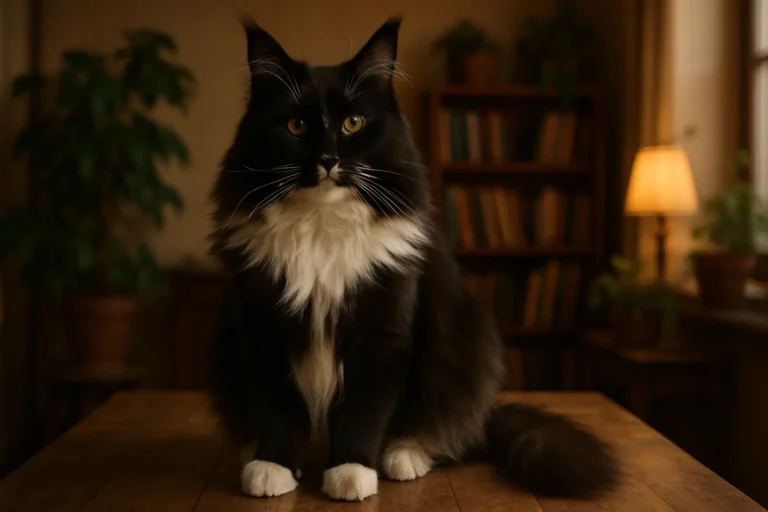
White Maine Coon: Rarity, Blue Eyes, and the Deafness Gene Explained
All the drama of a Maine Coon — the mane, the ear tufts, the sheer scale — rendered in pure white looks less like a house cat and more like something out of Norse mythology. But this color comes with genetics worth understanding before you fall in love, because the same trait that paints the coat can affect the cat’s hearing.
Quick Answer
Solid white Maine Coons are uncommon — roughly 1.5% of the breed. The white isn’t really a “color” at all: a dominant masking gene hides whatever color the cat carries underneath. White Coons can have blue, gold, green, or odd-colored eyes, and blue-eyed whites carry a real risk of congenital deafness, studied at 65–85%. Reputable breeders BAER-test hearing before you buy.
What Makes a Maine Coon White?
Two different genetic routes lead to a white coat, and they’re not the same thing. Dominant white is the usual cause: it doesn’t create white pigment, it switches off pigment entirely, masking whatever color the cat genetically is underneath. Breed a white Maine Coon and you might get black, tabby, or red kittens, because the hidden color passes on. Extreme white spotting is the same piebald gene that makes tuxedos and vans, dialed up to cover nearly the whole cat — these cats are technically “with white,” not true white. A telltale detail: many white kittens are born with a small smudge of color on top of the head, a peek at the masked color underneath, which usually fades by adulthood. See where white sits in the breed’s full palette in our colors guide.
How Rare Are White Maine Coons?
Around 1.5% of the breed — rarer than solid black and far rarer than tabbies. That said, treat “rare” marketing with the usual skepticism: white is a standard recognized color class that established catteries can produce intentionally. Expect scarcity and waiting lists; be wary of listings that use rarity alone to justify wild prices.
Eye Colors: Blue, Gold, Green, Odd-Eyed — and DBE
White is the one Maine Coon coat where every eye color is on the table: gold/copper and green are most common and carry the lowest deafness risk; blue is the showstopper, produced when the white gene also affects pigment in the iris; odd-eyed (one blue, one gold or green) is uncommon and highly sought after.
There’s a genuinely Maine Coon-specific wrinkle here worth knowing: the breed carries a separate trait called Dominant Blue Eye (DBE), tied to mutations in the PAX3 gene — genetically distinct from the ordinary white-masking gene, and similar to human Waardenburg syndrome. DBE can occasionally produce blue eyes on a cat that isn’t fully white, which is why you’ll sometimes see a blue-eyed Maine Coon that doesn’t fit the usual white-cat explanation. All kittens start with blue eyes, so a white kitten’s true adult eye color — and its actual deafness risk — isn’t clear until around four to six months.
The Deafness Question, Honestly
This is the part responsible breeders talk about up front. The gene that whitens the coat can also degrade the cochlea — the inner-ear structure that detects sound — and the risk tracks eye color.
| White Cat Type | Approximate Deafness Risk |
|---|---|
| Blue-eyed (both eyes) | 65–85% (often both ears) |
| Odd-eyed | ~40% (usually the ear on the blue-eyed side) |
| Gold or green eyed | 10–20% |
Three things worth knowing before this scares you off. Many blue-eyed whites hear perfectly — these are risk statistics, not verdicts. A responsible breeder will BAER-test white kittens (a quick, painless electrode hearing test) so you know before purchase; a breeder who’s never heard of BAER testing is a red flag. And deaf cats live full, normal indoor lives — they compensate with vibration and sight and learn hand signals quickly, though a deaf cat must stay strictly indoor since it can’t hear approaching danger.
White Maine Coon Personality
The coat changes nothing: white Coons carry the standard breed temperament — sociable, patient, dog-like, conversational in chirps (full details in our personality guide). Deaf individuals sometimes startle more easily at unexpected touch and may “shout” — vocalize loudly because they can’t hear themselves — both of which owners adapt to within weeks.
Keeping a White Coat White
- ✓Staining shows. Tear tracks, mouth stains, and litter dust are invisible on a tabby and glaring on white. A weekly wipe-down with a damp cloth handles most of it.
- ✓Occasional baths help this color — a whitening (bluing) cat shampoo a few times a year keeps the coat from yellowing.
- ✓Sun protection matters. White ears and noses lack protective pigment and can sunburn, another point favoring indoor life.
- ✓Diet shows up in the coat. A dull or yellowing white coat is often a nutrition flag — see our diet guide.
The standard brushing schedule still applies — three to four times weekly, daily during coat blow — covered in our grooming guide.
How Much Does a White Maine Coon Cost?
Pet-quality whites from reputable, health-testing breeders run the breed-standard $1,500–$3,000, with show lines at $2,500–$4,500. Blue-eyed and odd-eyed whites are frequently marketed at $4,000–$6,000 because demand is intense. A buyer’s note: a premium for blue eyes should come with a BAER test result, not instead of one. Everything else that justifies a price — HCM/hip testing, pedigree, rearing — is the same as any color; see our price guide.
Frequently Asked Questions
How rare is a white Maine Coon?
About 1.5% of the breed — one of the least common solid colors, rarer than black but readily produced by catteries that breed for it.
Are all white Maine Coons deaf?
No. Deafness risk depends on eye color: 65–85% for blue-eyed whites, around 40% for odd-eyed, 10–20% for gold or green eyed. A BAER hearing test gives a definitive answer per kitten.
Do white Maine Coons have blue eyes?
They can — white is the color most associated with blue and odd-colored eyes in this breed. Gold and green are actually more common in whites. A separate Maine Coon-specific trait, Dominant Blue Eye (DBE), can occasionally cause blue eyes outside the usual white-cat pattern.
What is a white Maine Coon "hiding" genetically?
Whatever color it truly is — the dominant white gene masks the coat rather than being a color itself. That’s why white parents can produce black, tabby, or red kittens.
How much is a white Maine Coon kitten?
Typically $1,500–$3,000 pet quality; blue-eyed or odd-eyed kittens from prominent catteries often list at $4,000–$6,000. Ask for health testing and a BAER result before paying any premium.
Are white Maine Coons high maintenance?
Slightly more than average for the breed: the same brushing schedule, plus stain wiping, occasional whitening baths, and sun awareness. Budget a few extra minutes a week, not hours.