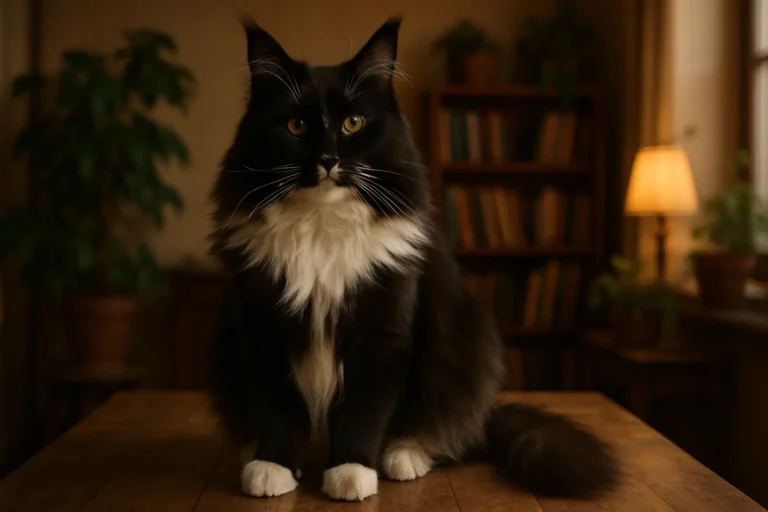
Maine Coon Colors and Patterns: The Complete Guide (80+ Combinations)
Ask three people to picture a Maine Coon and you’ll get three different cats: the classic brown tabby with the wild, bobcat look; a jet-black giant; a silver cloud with a white ruff. All of them are right. This breed comes in more coats than almost any other — and once you learn the handful of genetic ingredients behind it, “black silver torbie with white” stops sounding like a secret code.
Quick Answer
CFA and TICA recognize more than 80 color and pattern combinations in the Maine Coon. Every coat is built from a few ingredients: a base color (black, red, blue, or cream), an optional tabby pattern, optional silver/smoke shading, optional tortoiseshell mixing, and optional white patches. The brown classic tabby is the breed’s iconic, most common look.
How Maine Coon Colors Actually Work
Genetically, every Maine Coon starts from two pigments: black (eumelanin) and red (phaeomelanin). Everything else is a modifier layered on top. Dilution softens black into blue and red into cream. Tabby genes lay a pattern — swirls, stripes, or ticking — over the base color; this is the dominant, most common state, which is why tabby-patterned Maine Coons were the breed’s original look on Maine farms. The inhibitor gene bleaches the base of each hair, creating silver on tabbies and smoke on solids. Two X chromosomes can carry both black and red pigment at once, producing tortoiseshells — which is why torties are almost always female. And the white spotting gene splashes white anywhere from a chest locket to a mostly-white coat.
Stack those switches in different combinations and you get the whole 80+ catalog. Breeders shorthand it with EMS codes on pedigrees — useful to recognize even if you never need to use them yourself.
Solid Maine Coon Colors
| Color | What It Looks Like |
|---|---|
| Black | Deep, glossy black all over — panther vibes |
| Blue | Even slate grey, often with a silvery sheen |
| Cream | Pale, buttery buff — the dilute of red |
| Red | Rich orange, though “solid” reds almost always show faint ghost tabby markings |
| White | Pure white — technically a masking gene hiding another color underneath |
A genuinely solid, stripe-free red or orange Maine Coon is close to mythical — see our orange Maine Coon guide for why.
Tabby Patterns
Tabby is the breed’s signature — the original look of the working farm cats that founded the breed — and it comes in a few accepted forms. Classic tabby shows broad, marbled swirls with the famous “bullseye” circle on each side; this is the postcard Maine Coon. Mackerel tabby runs narrow parallel stripes down the ribs, like a tiger in miniature. Ticked (spotted) tabby breaks the pattern into salt-and-pepper flecks, with striping mostly on legs and face. Each pattern can sit on any base color — brown tabby, blue tabby, red tabby, and their silver versions. Every tabby, regardless of pattern, carries the trademark “M” on the forehead.
Smoke and Silver
These are the show-stoppers. The inhibitor gene strips pigment from the base of each hair, so the coat looks solid at rest — then flashes pale silver underneath the moment the cat moves. Smoke is the inhibitor on a solid cat; black smoke is the famous one, a black cat that shimmers grey-white in motion. Silver is the inhibitor on a tabby — the warm brown background of a normal tabby turns cool, gleaming silver with black markings, and silver tabbies rank among the most sought-after coats in the breed. Smoke and silver kittens are notoriously tricky to judge young: the effect often barely shows at eight weeks and deepens dramatically as the adult coat grows in.
Tortoiseshell, Torbie, and Calico
Mix black and red pigment in one coat and you get a tortoiseshell; add tabby markings on top and it’s a torbie; add large white patches and it’s generally called calico. Because the recipe requires two X chromosomes carrying different colors, these cats are almost always female — a male tortie is a genuine genetic rarity, occurring in roughly 1 in a few thousand. Folklore attributes torties a sassy streak (“tortitude”); there’s no science behind it, but the reputation persists.
Bicolor and White-Patched Coats
Any coat above can come “with white,” and where the white lands has its own vocabulary: a locket is a small chest spot, mitted means white paws, bicolor runs roughly a third to half white (the tuxedo Maine Coon is the black-and-white classic), harlequin is mostly white with big color patches, and van is white everywhere except the head and tail. White markings pair with everything — blue tabby with white, black smoke with white, silver torbie with white — and this combinatorial mixing is where most of the registry’s 80+ colors actually come from.
What About Eye Color?
Maine Coon eyes run green, gold, and copper, and unlike some breeds, eye color isn’t tied to coat color — with one exception. White and high-white cats can carry blue or odd-colored eyes (one blue, one gold). Interestingly, Maine Coons also carry a breed-specific trait called Dominant Blue Eye (DBE), caused by mutations in the PAX3 gene — genetically distinct from the ordinary white-masking gene that gives most white cats blue eyes, and similar to human Waardenburg syndrome. DBE can occasionally produce blue eyes even on cats that aren’t white. All kittens start with blue eyes regardless; true adult color settles in over the first few months. Our white Maine Coon guide covers the deafness risk tied to blue eyes in detail.
Rarest and Most Common Colors
Most common: brown classic and mackerel tabbies, with or without white — they dominate because tabby is genetically dominant and it’s the breed’s heritage look. Rarest: gold and silver shaded coats, true solid white, flawless solid black, and (rarest of all) male tortoiseshells. Fashionable rare colors often carry a price premium of a few hundred dollars — our price guide covers how much color actually moves the number. What color never changes is the cat inside: personality, health, and size are independent of coat.
Do Maine Coon Kittens Change Color?
More than you’d expect. Smokes and silvers develop their contrast over months; tabby patterns sharpen or blur as the adult coat comes in; reds deepen; and cold weather thickens and slightly darkens many coats. The coat you see at 10 weeks is a sketch, not the final painting — one more reason to choose a kitten on temperament and health rather than exact shade.
Frequently Asked Questions
How many colors do Maine Coons come in?
Over 80 recognized color and pattern combinations across five families: solids, tabbies, smokes/silvers, tortoiseshells, and any of those with white markings.
What is the rarest Maine Coon color?
Gold and silver shaded coats are generally considered rarest, along with true solid white and flawless solid black. Male tortoiseshells are the rarest single event in the breed.
What is the most common Maine Coon color?
The brown tabby — the classic “wild” look the breed is famous for, and the genetically dominant pattern tied to its farm-cat origins.
Do all Maine Coons have an M on their forehead?
All tabby Maine Coons do — it’s part of the tabby pattern itself, shared by tabby cats of every breed. Solid, smoke, and white Maine Coons don’t show it.
Can Maine Coons be orange?
Yes — genetically they’re red tabbies. The red pigment can’t fully hide tabby striping, so a truly solid orange Maine Coon essentially doesn’t exist.
Does coat color affect personality or price?
Personality: no, that’s folklore. Price: somewhat — fashionable colors like black smoke and silver often cost a few hundred dollars more purely on demand.