Maine Coon Ear Tufts and Lynx Tips: Why They Have Them
Those wispy hairs sprouting past the tips of a Maine Coon’s ears are the single most “wild” feature on an otherwise entirely domestic cat — enough that people genuinely ask whether the breed is part lynx. It isn’t. But the actual explanation involves a real, specific, only-recently-cited gene, a breed standard that most articles paraphrase rather than quote directly, and a fair amount of terminology people use interchangeably when it shouldn’t be.
Quick Answer
Maine Coon ear tufts (“lynx tips”) are long hairs at the ear tip, distinct from the softer inner “furnishings.” They’re linked to the same longhair genetics (the FGF5 gene) that gives Maine Coons their coat, likely evolved for cold-weather protection, and vary cat to cat — not every Maine Coon has dramatic tufts, and that’s entirely normal per both TICA and CFA standards.
Lynx Tips vs. Ear Furnishings vs. Tassel Ears: Getting the Terms Right
These three terms get used interchangeably online, including on some otherwise reputable Maine Coon sites, and they describe two genuinely different things:
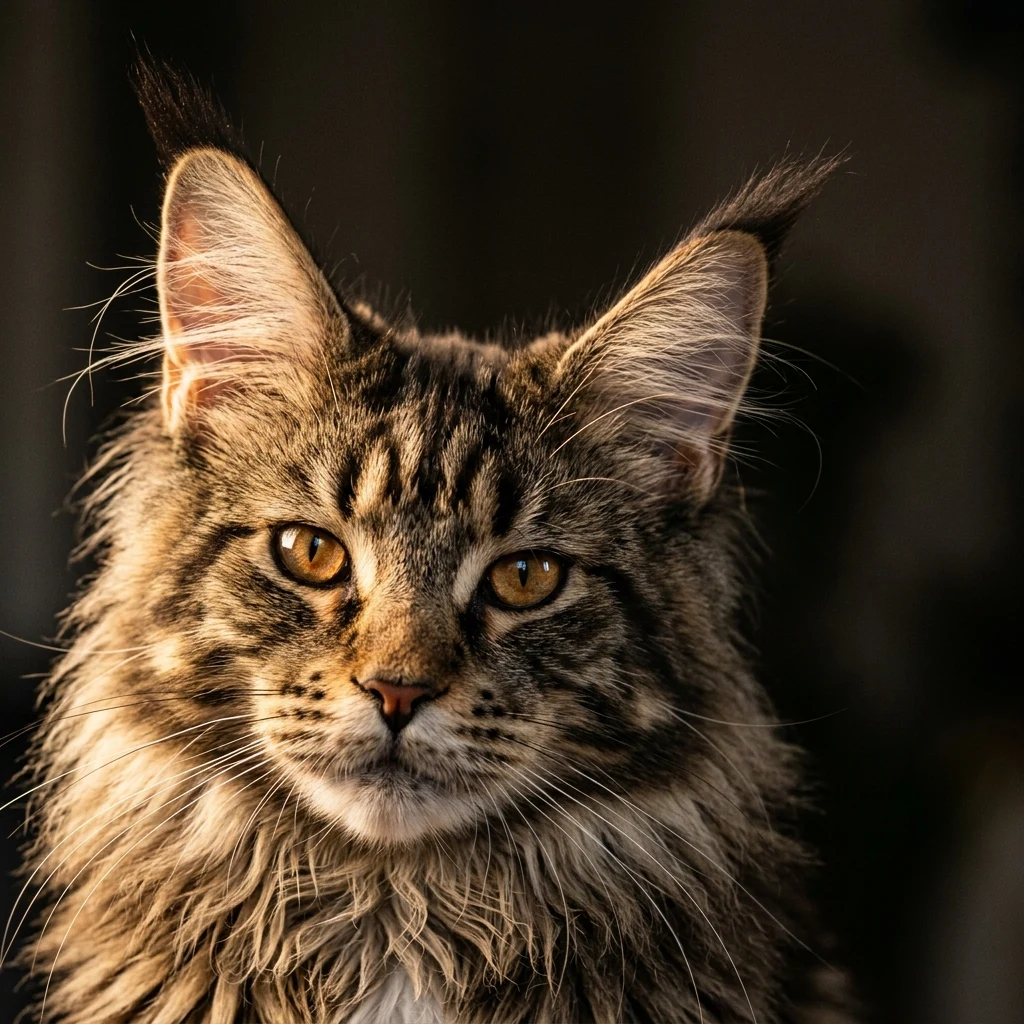
Lynx tips (sometimes “tassel ears”) refer to the long guard hairs extending vertically past the very tip of the ear — the dramatic, pointed wisps most people mean when they say “ear tufts.”
Ear furnishings refer to the softer hair growing from inside the ear canal opening, along the interior — a separate feature from the tip hairs, present to some degree on most longhaired cats.
Functionally, they likely do different jobs: lynx tips plausibly help direct sound into the ear; furnishings plausibly filter debris and help pick up finer sound vibrations. Both explanations are reasonable inference from function, not directly proven by a dedicated study — worth keeping in mind for the rest of this guide.
The Genetics: What Research Actually Shows
Most Maine Coon content covering ear tufts says “genetics” and stops there. The real underlying gene has a name: FGF5 (Fibroblast Growth Factor 5), which governs hair length generally — the same gene responsible for the Maine Coon being a longhaired breed at all, not tufts specifically. Foundational research (Kurushima et al.) identified multiple FGF5 variants across cat breeds associated with long hair, including a mutation found at high frequency specifically in Maine Coons, and later research (a 2021 paper in the journal Human Genetics) identified a distinct missense mutation associated with long hair in the breed.
Here’s the important nuance almost every article covering this topic glosses over: FGF5 explains why Maine Coons have long fur at all. It does not, on its own, explain why one Maine Coon has dramatic, pointed lynx tips and another has barely-there tufting. That specific variation in tuft prominence is commonly described as polygenic — influenced by hair length, growth direction, and follicle density near the ear tip working together — but no primary source we could find directly studies or cites this claim specifically. We’re stating it plainly: the “why do some Maine Coons have bigger tufts than others” question is reasonable inference repeated across blogs, not a directly cited finding, and it’s worth knowing the difference between the two claims.
When Do Maine Coon Kittens Develop Ear Tufts?
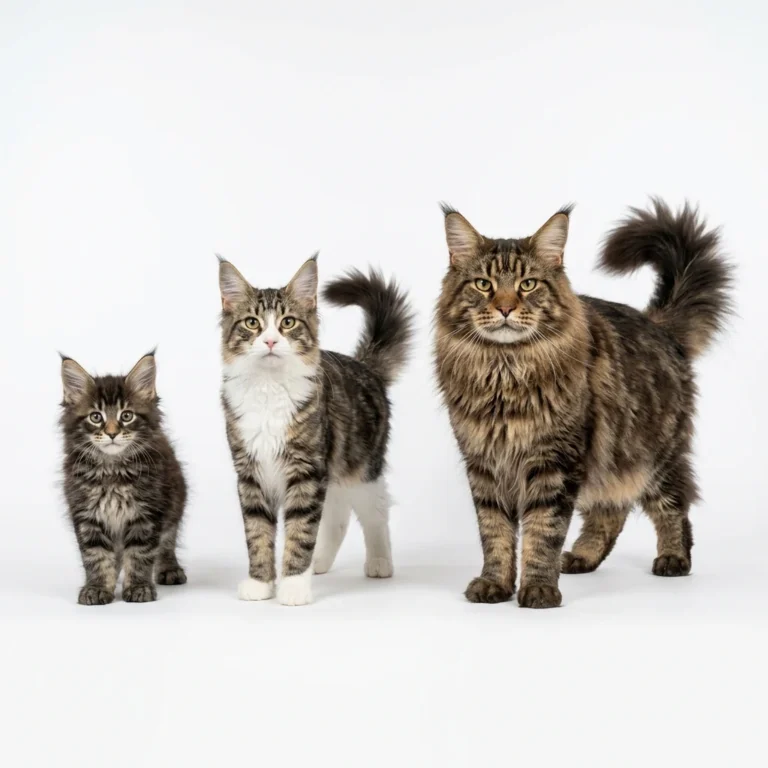
You’ll find genuinely conflicting timelines across different sources — some say tufts begin developing as early as 2 weeks old, others say 5–6 weeks, others describe it as a gradual process across “the first few months.” None of these specific timelines trace to a cited study. The most defensible, honest synthesis: furnishings are present in some form from early kittenhood, lynx tips become visibly distinguishable within the first couple of months, and full mature length and density isn’t reached until the cat’s entire coat matures — which, for this notably slow-developing breed, can take until 3–5 years old, tracking the same extended maturation timeline documented in our growth chart. Individual timing varies meaningfully, and that’s normal.
What Ear Tufts Are Actually For
Cold-weather protection is the best-supported functional explanation, consistent with the breed’s origin as a working farm and barn cat in harsh New England winters — tufts and furnishings plausibly help retain warmth and keep snow, moisture, and debris out of the ear canal.
Sound funneling gets repeated constantly — “the tufts direct sound waves into the ear” — but nearly every source making this claim simultaneously admits it’s “believed” or “not scientifically proven,” rather than citing an actual hearing study. Treat this one as folk theory, not established science, until real research says otherwise.
Purely decorative is a fair counterpoint for the visible lynx tips specifically, as distinct from the more plausibly functional inner furnishings — some sources make this distinction explicitly, and it’s a reasonable balance against the more confident “definitely helps them hear better” claims elsewhere online.
Do All Maine Coons Have Them? Is It a Breed Standard?
Sources genuinely contradict each other on this point online, with some claiming lynx tips are essentially required and others claiming breed standards don’t mention them at all. Neither extreme is quite right. TICA’s official Maine Coon breed standard describes tufts as an “enhancing feature, not a requirement” — present and desirable, but not disqualifying if absent. CFA’s standard uses descriptive language like “large, well-tufted” for the ears generally, while also cautioning against any “exaggerated” features — tufting is expected as part of the overall ear description, but isn’t itself a scored, pass/fail disqualifying trait the way toe count is for polydactyly.
The practical answer: a genuine, healthy purebred Maine Coon without dramatic lynx tips is entirely normal and not somehow less “real” — tuft prominence is one visual trait among many the standard considers, not a mandatory checkbox.
Other Cold-Climate Cousins: Which Other Breeds Have Ear Tufts
Ear tufts and furnishings appear across a genuine cluster of breeds, most sharing either longhair genetics or a cold-climate origin story: American Curl, Birman, Highlander (a Maine Coon-derived breed), LaPerm, Maine Coon, Nebelung, Norwegian Forest Cat, Persian, Pixie-bob, Ragdoll, Siberian, Somali, Turkish Angora, Turkish Van, and American Bobtail. Many random-bred Domestic Longhairs and even some Domestic Shorthairs carry visible furnishings too, regardless of any registered breed — another reason tufted ears alone are weak evidence in any “is my cat part Maine Coon” identification exercise.
Are Maine Coons part lynx or bobcat? No — genetically impossible, different species entirely. The resemblance is convergent (similar traits evolving independently for similar cold-climate reasons), not ancestry, the same category of myth as the raccoon origin story.
Part of a Bigger Cold-Weather Toolkit
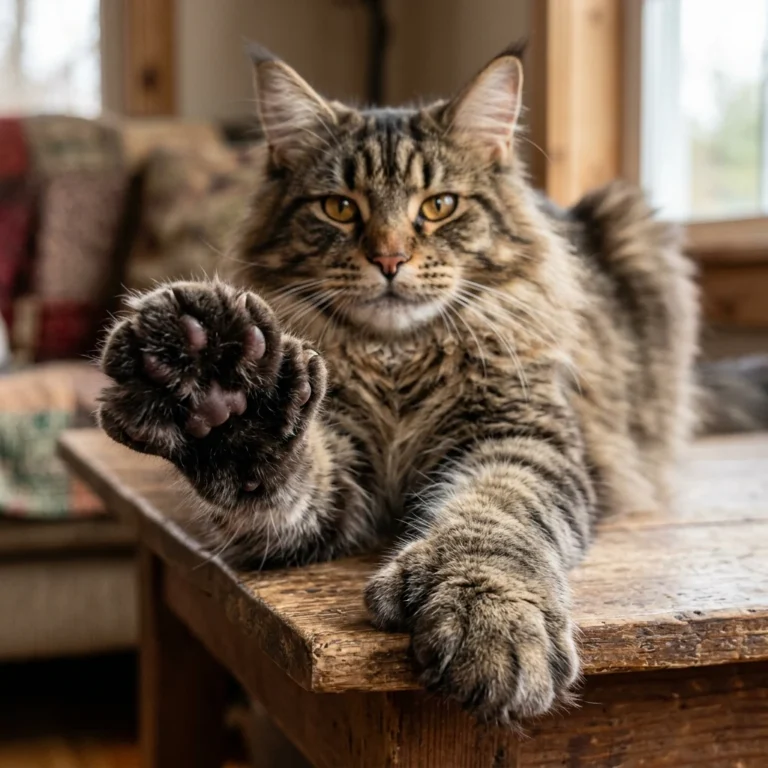
Ear tufts don’t exist in isolation — they’re one piece of a broader set of cold-climate adaptations this breed carries together: the dense, water-resistant double coat; the long, bushy tail the cat can wrap around itself like a scarf; and the large, heavily-furred paws that sometimes carry extra toes, functioning as natural snowshoes. Seen as a set rather than individually, these traits tell a consistent story about a cat shaped by genuinely hard New England winters — a framing almost no other article covering ear tufts specifically makes, despite it tying the whole picture together.
Caring for Ear Tufts
Ear tufts and furnishings need essentially no special grooming beyond normal coat maintenance — they don’t typically mat the way body fur can, since they’re shorter and less dense than the ruff or britches. Regular ear checks (looking for wax buildup, debris, or odor, same as any cat) matter more than any tuft-specific care. For show preparation, groomers may lightly comb tufts to keep them tidy, but this is cosmetic, not a health necessity. See our full grooming guide for the complete coat-care picture.
Frequently Asked Questions
Why do Maine Coons have ear tufts?
Ear tufts (lynx tips) are linked to the same FGF5 longhair genetics that give Maine Coons their coat, and likely evolved for cold-weather protection given the breed’s New England farm-cat origins. The specific reason some individuals have more dramatic tufts than others is less well understood.
Do all Maine Coons have lynx tips or ear tufts?
No. TICA describes tufts as an “enhancing feature, not a requirement,” and CFA doesn’t treat missing or minimal tufting as disqualifying. A purebred Maine Coon without dramatic lynx tips is completely normal.
What is the difference between ear tufts and ear furnishings?
Ear tufts (lynx tips) are the long hairs extending past the tip of the ear. Ear furnishings are the softer hair growing from inside the ear canal opening. They’re distinct features, though the terms are often used interchangeably online.
Are Maine Coons part lynx or bobcat?
No — this is biologically impossible, since they’re different species. The lynx-like tufted ears are convergent evolution (similar cold-climate adaptation), not shared ancestry, similar to the debunked raccoon-ancestry myth.
At what age do Maine Coon kittens develop ear tufts?
Sources vary, but furnishings are present in some form from early kittenhood, with lynx tips becoming visibly distinguishable within the first couple of months. Full mature tufting isn’t reached until the coat fully matures, which can take up to 3–5 years in this slow-developing breed.
Do ear tufts help cats hear better?
It’s a commonly repeated claim, but not scientifically confirmed — most sources making it admit it’s a theory rather than proven science. Cold-weather protection is the better-supported functional explanation for the trait.
What other cat breeds have ear tufts?
Several, including the Norwegian Forest Cat, Siberian, Turkish Van, Turkish Angora, Ragdoll, Persian, and American Curl, among others — most sharing either longhair genetics or a cold-climate origin. Many random-bred longhaired cats show the trait too, regardless of breed.