Polydactyl Maine Coon: The Extra-Toed Cats, Explained
Somewhere between one-in-three and one-in-forty of the original Maine Coon population walked around on paws with a few extra toes — useful for balance on a pitching ship deck or a snowbound farm, and today the single most distinctive variant of an already distinctive breed. Extra toes sound like a minor curiosity until you look at what recent genetics research has actually found: a specific mutation, a second unexplained cause hiding in one bloodline, and real clinical data on whether it affects a cat’s health at all.
Quick Answer
A polydactyl Maine Coon is a Maine Coon born with extra toes — usually 6 or 7 per front paw instead of the standard 5 — caused by a dominant mutation in a limb-development gene. TICA recognizes them as their own breed group (MC/MCP); CFA registers them but doesn’t permit them in championship showing. Clinical research has found no meaningful health downside to the extra digits.
What Is a Polydactyl Maine Coon?
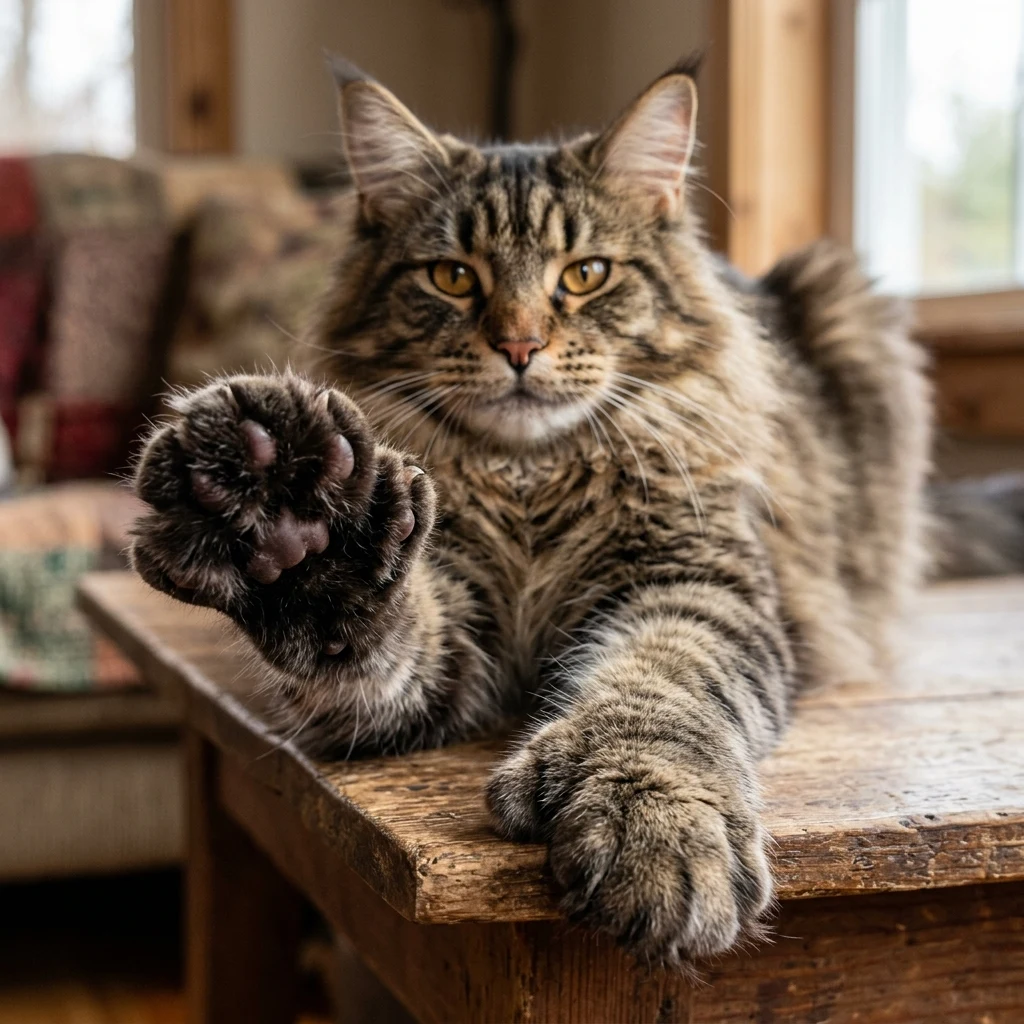
A standard cat has 18 toes total: five on each front paw, four on each back paw. A polydactyl Maine Coon typically carries one or two extra toes per affected paw, most often on the front, occasionally on all four. Breeders and owners often shorthand the count as a ratio — “7/7/6/6” meaning seven toes on each front paw and six on each back. The extra digits usually sit along the inner edge of the paw, giving it a noticeably wider, rounder, sometimes almost mitten-like look.
The trait is autosomal dominant, meaning a kitten only needs to inherit the mutation from one parent to be polydactyl — unlike recessive conditions that need two copies. Pairing one polydactyl (heterozygous) parent with a standard-toed parent gives each kitten roughly a 50% chance of being polydactyl, straightforward dominant-trait math.
The Gene Behind the Extra Toes: What 2020–2024 Research Actually Found
Most articles on this topic say “dominant gene” and stop there. The actual mechanism is more specific and more interesting: the mutation sits in a region called the ZRS (Zone of Polarising activity Regulatory Sequence), a non-coding regulatory stretch inside an intron of the LMBR1 gene, which in turn controls limb-development expression of the Sonic Hedgehog (SHH) gene — a gene with an admittedly unserious name but a genuinely central role in how limbs and digits form in the embryo. Three known ZRS variants cause polydactyly in cats generally: two (UK1, UK2) found in outbred British cats, and a third — the “Hw” (Hemingway) variant — found specifically in US-origin Maine Coon lines.
A 2020 study (Hamelin et al., Journal of Feline Medicine and Surgery) sequenced 75 Maine Coons — 48 polydactyl, 27 non-polydactyl — and found something genuinely unexpected: of the 48 polydactyl cats, 18 were heterozygous carriers of the Hw variant and 1 was homozygous, but 29 carried no known ZRS variant at all. Every one of those 29 unexplained cases traced back to the Canadian breeding line — meaning Canadian-line Maine Coon polydactyly is caused by a completely different, still-unidentified genetic locus, distinct from the American Hw mutation. The study also found 2 non-polydactyl cats who unexpectedly carried the Hw variant anyway — direct evidence of incomplete penetrance, meaning you can carry the gene and simply not show the trait. The real inheritance pattern is therefore best described as autosomal dominant with incomplete penetrance and variable expressivity, not the simple textbook dominant trait most sources describe.
Two Paw Types: Mitten-Paw vs. Patty-Foot, and What a 2024 Clinical Study Found
A 2024 clinical characterisation study examined 70 Maine Coons — 48 polydactyl (across German, Canadian, and two US lines) plus 22 non-polydactyl controls, ages 3 months to 10 years — and formally defined two distinct paw phenotypes. “Mitten-paw” describes a shorter, separate extra digit, typically seen in US-line cats. “Patty-foot” describes extra digits of equal length forming a continuous, wider paw, more associated with the Canadian line — consistent with that line carrying its own distinct, separate genetic cause.
Extra digits ranged from 2 to 6 extra total per cat in the study. Sixteen of the Canadian-line cats had six digits on all four paws, and 23 of 31 Canadian-line cats showed symmetrical polydactyly left to right. On X-ray, researchers found some genuinely novel skeletal differences — an absent radial sesamoid bone (in all 12 examined Canadian-line cats), an extra “carpal-0” bone (8 of 12), an enlarged central tarsal bone (7 of 12), and occasional tarsal bone fusion (2 of 12). Despite all of that structural variation, only 1 of the 48 polydactyl cats showed any lameness — and it was unrelated to the extra toes. No statistically significant bone-size differences were found versus non-polydactyl controls. The study’s own conclusion: broad phenotypic diversity, with no apparent welfare or health consequences.
How Common Is Polydactyly — Then and Now
The oft-repeated “up to 40% of early Maine Coons were polydactyl” figure traces to the breed’s unregulated working-cat origins, where nobody was selecting against the trait. What today’s actual prevalence looks like is genuinely unclear — several blogs quote a specific modern range (commonly “2–15%”) with no traceable source behind it. The honest answer is that no rigorous, published, population-wide prevalence study exists for the current era, and we’d rather say that plainly than invent a precise-sounding number.
| Era / Context | Prevalence | Notes |
|---|---|---|
| Historical (pre-1950s, unregulated population) | ~40% | Cited across breed history sources; the trait was simply common in the working farm-cat population |
| Modern day (precise figure) | Not well documented | No published population-wide survey exists; treat any specific modern percentage you see online with skepticism |
| CFA show lines specifically | Very low | The CFA standard excludes polydactyly from championship showing, so breeders selecting for the show ring actively breed it out |
The Hemingway Connection: Ship’s Cats and a Six-Toed Legacy
“Hemingway cat” has become informal shorthand for any polydactyl cat, tracing back to a real story: a white six-toed ship’s cat named Snow White, reportedly given to Ernest Hemingway by a ship’s captain in Key West in the 1930s. Today the Ernest Hemingway Home and Museum in Key West houses roughly 60 cats, about half of which visibly display extra toes, descended from that original closed colony.
The broader historical theory holds that polydactyly clustered along the New England and Atlantic Canada coastline, and separately in southwest England and Wales, correlating with historic shipping-trade routes — sailors reportedly valued six-toed cats as good luck and, more practically, as steadier climbers and ratters aboard a rolling ship. Whether the mutation originated in New England or was imported from England via those same trade routes is genuinely disputed among breed historians, not a settled fact — a nuance almost no blog covering this topic acknowledges, most simply asserting the “natural snowshoes for snow” explanation as if it were proven adaptive biology rather than a plausible, unproven theory.
CFA vs. TICA: Where Polydactyl Maine Coons Stand in the Show Ring
TICA formally recognizes Maine Coon Polydactyl (MCP) as its own breed group alongside the standard Maine Coon (the combined breed listing is written MC/MCP), accepted into TICA Championship competition starting May 1, 2015.
CFA does not accept polydactyl cats for championship showing. Its Maine Coon standard specifies exactly “five toes in front; four in back” and disqualifies any deviation. CFA does register polydactyl Maine Coons, and they can compete as neuters in the Household Pet category — they’re simply excluded from the pedigree championship ring, not banned from the registry entirely.
Breeding Odds: What Happens When You Pair a Polydactyl With a Standard Maine Coon
Because polydactyly is dominant, pairing one polydactyl (heterozygous) parent with a standard-toed partner gives each individual kitten roughly a 50% chance of being polydactyl — simple dominant-trait math, though the 2020 study’s finding of incomplete penetrance means that percentage describes genetic inheritance, not a guaranteed visible outcome in every case; a kitten can carry the gene without visibly showing extra toes.
Are Extra Toes Healthy? Separating Fact From Myth
The clinical data above is reassuring: in the 2024 study, only 1 of 48 polydactyl cats showed any lameness, and it wasn’t caused by the extra digits. Day-to-day, the main practical difference is grooming — extra toes mean extra nails, and the additional digit’s nail can sometimes grow at an angle that doesn’t naturally wear down the way standard nails do, making it more prone to overgrowth or, rarely, ingrowing if neglected. Regular nail checks and trims matter a bit more for a polydactyl cat, not because the paw is fragile, but because there’s simply more nail to keep an eye on.
Record-Holders and Famous Polydactyls
The historic Guinness World Record for most toes on a cat belongs to Jake, a Canadian polydactyl cat with 28 toes total (7 per paw), set in 2002. That record has since been tied more than once — most recently in June 2026, when a Michigan kitten named Toby was confirmed at 28 toes, matching a similar recent case in a Canadian/Minnesota-area cat named Paws. Twenty-eight toes appears to be close to the practical ceiling for the trait — a genuine, current data point almost no other article covering this topic currently has.
Frequently Asked Questions
What is a polydactyl Maine Coon?
A Maine Coon born with extra toes — usually 6 or 7 per front paw instead of the standard 5 — caused by a dominant mutation affecting a limb-development gene. TICA recognizes them as their own breed group (MC/MCP); CFA registers them but excludes them from championship showing.
Are polydactyl Maine Coons rare?
Historically no — up to about 40% of the original working-cat population is estimated to have carried the trait. Today’s exact prevalence isn’t well documented, though show-line breeding has reduced it in cats bred specifically for CFA championship competition.
Is polydactyly in Maine Coons dominant or recessive?
Dominant — a kitten needs only one copy of the mutated gene from either parent to potentially show extra toes. Research has also found incomplete penetrance, meaning some cats carry the gene without visibly showing the trait.
Do CFA and TICA both accept polydactyl Maine Coons for showing?
No. TICA recognizes Maine Coon Polydactyl as its own breed group and allows championship competition. CFA registers polydactyl cats but its breed standard requires standard toe counts, so they can only compete as neuters in the Household Pet category.
Do extra toes cause health problems in Maine Coons?
Clinical research on 48 polydactyl Maine Coons found only one case of lameness, unrelated to the extra toes, and no significant bone-size differences versus standard cats. The main practical consideration is more diligent nail care, since extra digits mean extra nails to monitor.
What is a Hemingway cat?
An informal nickname for any polydactyl cat, tracing to a six-toed ship’s cat named Snow White reportedly given to Ernest Hemingway in the 1930s. The Hemingway Home in Key West still houses roughly 60 cats today, about half visibly polydactyl.
Can two non-polydactyl Maine Coons produce a polydactyl kitten?
Very rarely, and only if a parent carries the gene without visibly showing it — a phenomenon called incomplete penetrance confirmed in a 2020 genetic study. In the vast majority of cases, at least one visibly polydactyl parent is involved.